Hypoestes phyllostachya – a tropical accent in vertical gardens and green walls
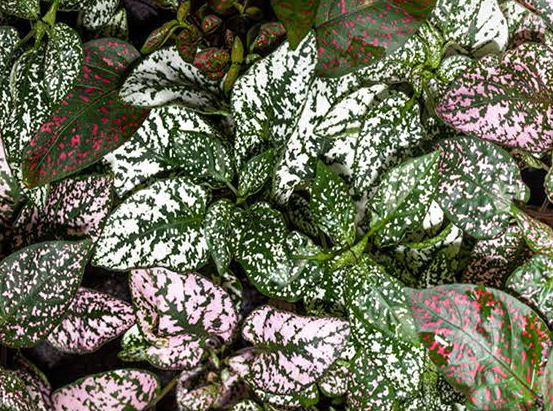
Hypoestes phyllostachya, commonly known as the polka dot plant, is a plant that catches the eye from first glance – and it doesn’t need flowers to do so. Its spotted, colorful leaves work perfectly in vertical gardens and modern offices, where greenery has a significance greater than just decorative.
In well-designed systems, Hypoestes behaves calmly and predictably. It doesn’t cause problems, and at the same time does exactly what we expect from it – enlivens the interior, improves the microclimate, and naturally fits into the biophilic approach to space design.
Natural occurrence and character of Hypoestes phyllostachya
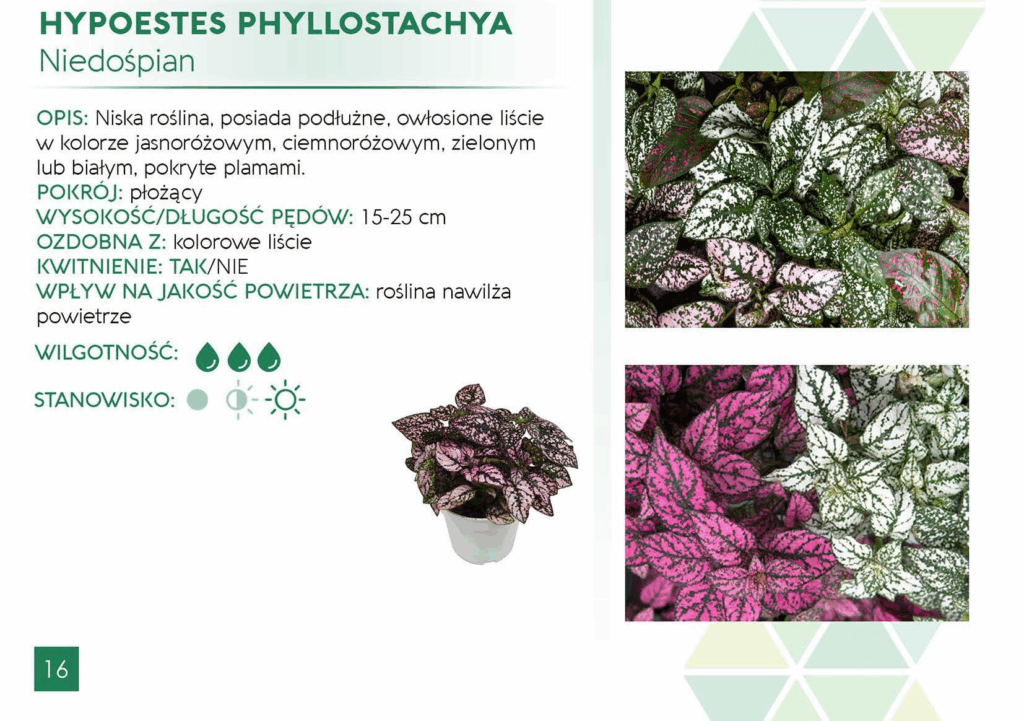
Hypoestes phyllostachya, known in Poland as niedośpian, comes from humid tropical regions – mainly from Madagascar, South Africa, and Southeast Asia. In its natural environment, it grows low to the ground, in semi-shade, sheltered by larger plants. This is important information because these are exactly the conditions we try to recreate in the 4Nature System in modern office interiors.
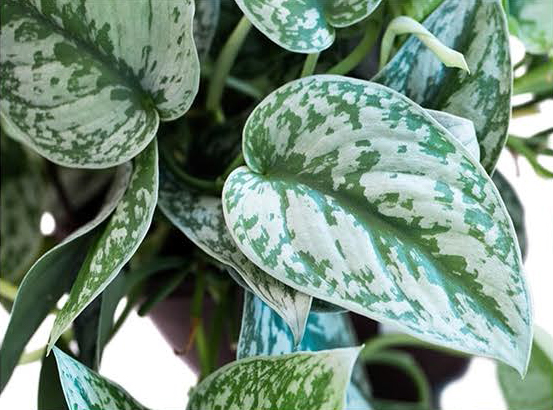
The plant forms compact, dense clumps and immediately attracts attention with its spotted leaves – pink, white, or red on a green background. Thanks to this, Hypoestes works excellently as a color accent in living plant walls and in compositions where greenery is meant not just to “be there,” but to genuinely build the character of the space. In practice, it is often combined with other foliage plants, which shows well how diverse a green wall in an office can be.
Light and conditions in vertical gardens – requirements to remember
The best location for Hypoestes is bright but diffused light. Direct sun quickly burns the leaves, and too deep shade causes loss of intense colors. That’s why the plant ideally finds itself in vertical gardens and systems where light is designed consciously, not “by the way.”
In vertical gardens, the key factors are:
- stable substrate moisture,
- constant temperature above 15°C,
- even irrigation across the entire wall surface,
- controlled light conditions.
That’s exactly why Hypoestes works well in solutions such as furniture with built-in vertical gardens – the plant has everything it needs, and users don’t have to worry about daily care. This approach perfectly fits into the philosophy of designing greenery in the office, which we write about on our blog.
How does Hypoestes phyllostachya affect air quality and employee wellbeing?
Although Hypoestes is not a “filter plant” in the laboratory sense, its real value in offices lies in something else. The polka dot plant humidifies the air and supports the creation of a stable microclimate, which is important especially in air-conditioned spaces.
Plants with distinctive leaves, such as Hypoestes, also affect:
- stress level reduction,
- improved concentration,
- visual “warming” of the space,
- greater sense of comfort in the workplace.
This is exactly the effect we talk about in the context of biophilic design and employee wellbeing. In practice, Hypoestes works excellently in common areas, receptions, and at workstations, where greenery is meant to have a calming effect, not be distracting.
Hypoestes phyllostachya – care in 4Nature System green walls
In a classic pot, Hypoestes can be capricious. In vertical gardens, however, the situation looks completely different. When the plant has automatic irrigation and stable conditions, it starts to grow calmly and predictably – exactly as we expect in office spaces.
From our experience at 4Nature System, the key factors are:
- regular, moderate watering, without drying out the substrate,
- high air humidity, particularly important in air-conditioned offices,
- periodic trimming, which allows maintaining a dense, aesthetic habit,
- stable conditions, without drafts and sudden temperature changes.
That’s why the polka dot plant works best in solutions we design as complete systems – such as 4Nature Basic, 4Nature N’joy, or 4Nature Amstel. In these furniture pieces, care is built into the technology, not transferred to users.
This approach significantly reduces the risk of problems we often encounter with poorly selected plants and random arrangements. That’s exactly why we regularly address this topic on our blog – for instance, in the text about what happens when something starts to go wrong with plants.
Frequently asked questions about Hypoestes phyllostachya
Is Hypoestes phyllostachya suitable for vertical gardens?
Yes, Hypoestes works very well in vertical gardens, provided stable moisture and diffused light are ensured. In systems with automatic irrigation, it grows predictably and maintains intense leaf colors.
What is the best location for Hypoestes phyllostachya in an office?
The best is a bright location with diffused light, without direct sunlight. Too harsh sun can cause fading or burning of the leaves.
Does Hypoestes improve indoor air quality?
The polka dot plant is not a typical air-purifying plant, but it helps humidify the air and stabilize the microclimate. This is particularly important in air-conditioned offices.
Is Hypoestes phyllostachya difficult to care for?
In a pot it can be demanding, but in vertical systems its care is much simpler. Automatic irrigation and condition control eliminate most problems.
Why does Hypoestes work well in 4Nature System green walls?
Because it has exactly the conditions it needs: constant moisture, appropriate light, and stable temperature. Thanks to this, it doesn’t burden users with daily care and maintains its aesthetic appearance for a long time.
Sources:
https://en.wikipedia.org/wiki/Hypoestes_phyllostachya
https://powo.science.kew.org/taxon/urn:lsid:ipni.org:names:49962-1
https://plants.ces.ncsu.edu/plants/hypoestes-phyllostachya
https://efloraofindia.com/efi/hypoestes-phyllostachya