Fittonia verschaffeltii – a small plant that makes a big difference in green arrangements
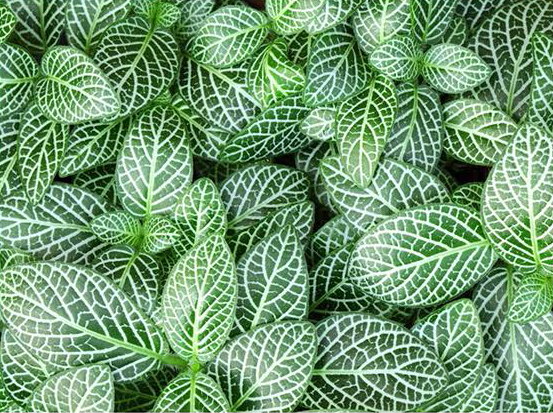
Fittonia verschaffeltii is one of those plants that at first glance seem inconspicuous. Low-growing, creeping, delicate. Yet in well-designed green walls, it can do exactly what we expect from greenery in offices or public spaces – it calms, organizes the composition, and improves comfort indoors. Without being imposing.
Where does Fittonia verschaffeltii occur?
Fittonia verschaffeltii comes from the humid rainforests of South America. In nature, it grows low, close to the ground, in the shade of larger plants. It’s a typical understory plant – it doesn’t compete for light, doesn’t dominate, but calmly fills the space.
This origin strongly defines its behavior indoors. Fittonia:
- feels comfortable in places with limited light access,
- prefers stable conditions,
- “likes” the proximity of other plants.
That’s why it appears so often in projects such as custom living walls or larger vertical gardens, where it creates a green background for more expressive species. It’s a plant that binds everything together and makes the composition look natural, not like a random collection of pots.
Light requirements of Fittonia verschaffeltii
The most important rule for fittonia is simple: diffused light, without direct sun. In nature, sunlight is filtered through tree canopies – and these are exactly the conditions worth providing indoors.
In vertical systems, fittonia works very well because it:
- doesn’t require intensive lighting,
- maintains a compact habit,
- doesn’t “escape” from the composition.
In practice, it functions best where:
- lighting is even,
- air humidity is stable,
- the irrigation system works regularly.
That’s why it’s often used in greenery integrated with architecture, such as in furniture with built-in vertical gardens. In our solutions such as 4Nature Basic, 4Nature N’joy, or 4Nature Amstel, fittonia has exactly what it needs – a controlled environment and predictable conditions.
Fittonia verschaffeltii – what is its impact on air quality and employee wellbeing?
Fittonia, like most green plants, participates in gas exchange and supports the microclimate of interiors. Its leaves help reduce some volatile organic compounds present in the air, which combined with other plants has real significance in office spaces.
But even more important is the psychological aspect. Greenery with small leaves:
- reduces tension,
- has a soothing effect on eyesight,
- promotes concentration.
It’s no coincidence that this topic regularly appears in analyses such as the impact of vegetation on office workers’ well-being. Fittonia doesn’t play the leading role here, but without it, many arrangements would simply be “too harsh” visually.
Care in 4Nature System green walls of Fittonia verschaffeltii
In a pot placed on a windowsill, fittonia can be capricious. In green walls – quite the opposite. The key here is proper conditions and well-conducted plant adaptation, not the fittonia itself.
Fittonia needs:
- constant air humidity,
- slightly moist but permeable substrate,
- no drafts and sudden temperature changes.
Systematic solutions ensure that:
- watering is regular,
- roots are not flooded,
- the plant doesn’t dry out.
That’s why fittonia thrives so well in professionally designed installations, where green wall maintenance is a planned and regular process. At 4Nature System, we ensure this at every stage – from plant adaptation, through condition selection, to constant system greenery service. It’s a plant that repays with calm growth and stable appearance – provided we don’t leave it to itself.
Frequently asked questions about fittonia verschaffeltii
Is fittonia suitable for offices and public spaces?
Yes, fittonia works very well in offices, receptions, and common spaces. It functions best as part of a larger plant composition, such as a green wall. In stable conditions, it’s a predictable and aesthetic plant.
Does fittonia require a lot of light?
No, fittonia prefers diffused light and partial shade. Direct sunlight can cause leaf burns and color loss. That’s why it thrives in interiors with controlled lighting.
Is fittonia difficult to care for?
In a classic pot, it can cause problems, especially in dry atmosphere. In green walls, where humidity and watering are controlled, its care is much simpler. The key is conditions, not “special treatments.”
Does fittonia improve air quality?
Fittonia participates in natural gas exchange and supports the indoor microclimate. Its impact is greatest as an element of a larger plant system. Combined with other plants, it contributes to comfort in the space.
Why is fittonia often used in green walls?
Because it has a low, creeping habit and fills the space between other plants well. It doesn’t dominate the composition but organizes and visually calms it. That’s exactly why designers reach for it so willingly.
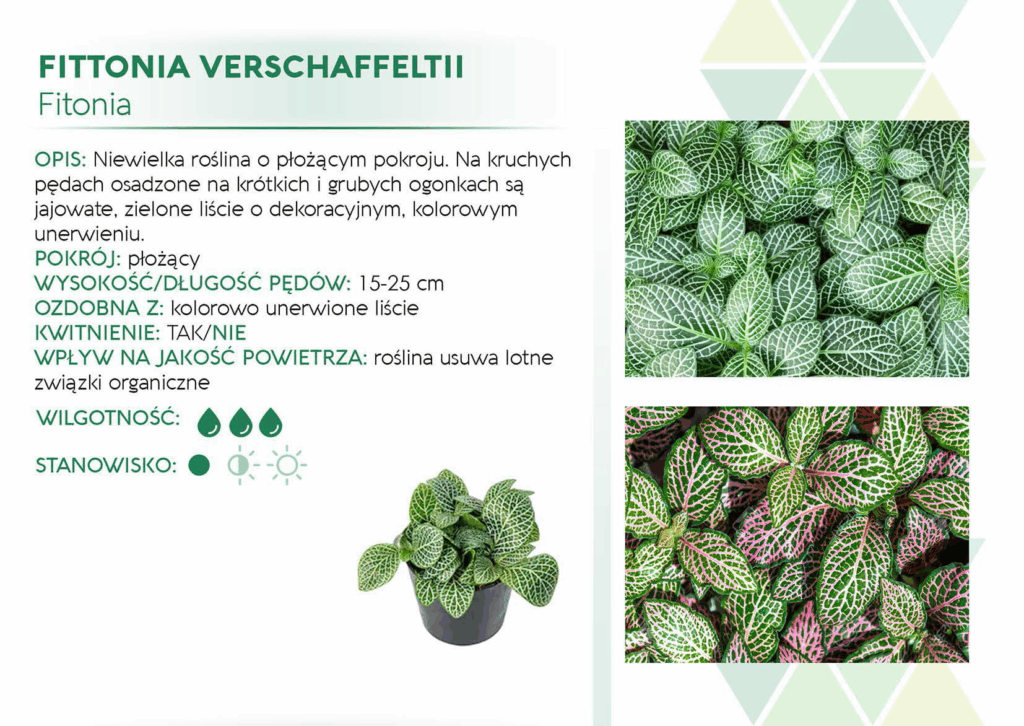
Sources:
https://www.medianauka.pl/Fitonia-verschaffeltii
https://plantsw.app/atlas/plant/fittonia–