Office space and stress – how the layout affects the team’s recovery and resilience

Work-related stress does not begin with the colour of the walls and does not disappear once a few plants have been placed around. Noise, a lack of privacy, poor lighting or constant background conversation can, however, add further stimuli to an already demanding working day. A well-designed office will not replace proper work organisation, but it can make it easier to concentrate, take a short break and recover energy. This is precisely why space is increasingly treated as one of the components of workplace wellbeing.
How does office space affect stress levels?
The physical environment can either increase or reduce the load people carry during work. This does not mean that interior design “cures” stress or burnout. It is about something simpler: an office can add noise, social exposure and a lack of control, or it can offer quiet, privacy and the option to change location.
The WHO reports that around 15% of working-age adults experience a mental disorder at any given time, and that depression and anxiety disorders cost the global economy around USD 1 trillion a year. These figures concern the broader issue of mental health at work, not office design itself.
Working conditions are shaped among other things by:
- the noise level and the number of interruptions to concentration,
- access to privacy and a quiet place,
- daylight and the quality of lighting,
- the indoor microclimate and air quality,
- the ability to choose a setting suited to the task at hand.
At 4Nature System we see greenery as one element of a larger system. Biophilia covers contact with nature, light and views, while a vertical garden makes it possible to introduce planting where there is no room for yet another pot.
Environmental sources of tension in the office
The biggest problem is usually created by the sum of small burdens rather than a single factor. Background conversations, movement near the workstation, a lack of privacy and constant attention switching can act as a steady “hum” weighing on an employee for several hours.
In the study by Jahncke and colleagues, working at 51 LAeq instead of 39 LAeq was associated with poorer recall, greater fatigue and lower motivation. Other experiments showed that intelligible background speech reduces accuracy in text-based tasks.
The most common environmental sources of tension include:
- noise and colleagues’ conversations,
- a lack of acoustic and visual privacy,
- too little daylight,
- stuffiness, dryness or an uncomfortable temperature,
- cramped conditions and desks placed along circulation routes,
- nowhere to take a short break.
Light matters too. In a pilot study by Boubekri and colleagues, employees without access to windows reported poorer vitality and sleep quality. That is a signal that office conditions may also be linked to recovery after work.
In larger open-plan spaces, functional zoning is a good direction. Furniture with a built-in vertical garden can serve as a green divider between zones. It will not replace an acoustic design, but it helps separate workstations visually and bring order to an open space.
Attention restoration – why doesn’t a break at your desk work?
Recovery requires a change of stimuli, and staying in front of the same screen usually does not provide one. A short break can work better if the employee steps away from the workstation, limits conversation and spends a moment in different surroundings.
A recovery zone should therefore be more than a designer lounge. If it sits next to the kitchen, the printers and the main walkway, it may look good but offer no real calm.
Such a space should make it possible to:
- step away from the screen,
- reduce conversation and other stimuli,
- change body position,
- have contact with daylight or greenery,
- choose between solitude and a quiet conversation.
Research points to the possibility of designing places that allow for 5–15 minutes of genuine detachment from the typical work environment. This is not a universal health standard, but a practical design guideline.
| Type of recovery | Employee’s need | How the space responds |
| individual | quiet and privacy | quiet zone, intimate seating, no screens |
| social | relaxed conversation | informal zone, shared table, soft seating |
| sensory | a change of stimuli | daylight, a view of greenery, calmer surroundings |
| physical | a change of position | the option of a short walk or rest away from the desk |
Contact with nature is one of the better-documented ways of supporting recovery. A systematic review of 12 studies pointed to favourable results linked among other things to access to outdoor areas and restorative spaces.
That is why a vertical garden placed within sight of a rest area can be more functional than a few randomly positioned planters.
If dry air is a problem in your office, see which air-humidifying plants work well in workspaces and how, at 4Nature System, we use living greenery as one of the elements supporting a comfortable microclimate.
How to design a space that supports recovery?
A good office gives employees a choice of setting suited to the task in hand. Someone running a meeting needs a different space than someone analysing a report, and different again from an employee who wants to cut themselves off from conversation for a few minutes.
First, acoustics. A quiet zone next to the kitchen or the printer will remain quiet mainly on the floor plan. What is needed are appropriate distances, sound-absorbing materials, phone booths and places for work that requires focus.
It is worth checking:
- whether employees really have a choice of where to work,
- whether a genuinely quiet zone exists,
- whether workstations have access to daylight,
- whether greenery is within the user’s field of view,
- whether the rest area differs from the work area.
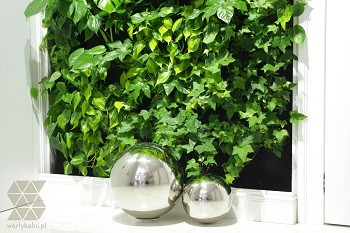
An interior can also be organised with greenery. Plant walls work well as a larger biophilic element, while furniture with living greenery makes it possible to bring planting closer to workstations and informal zones.
Species suited to such installations include golden pothos, heartleaf philodendron, peace lily, spider plant and nephrolepis. The species must, however, match the lighting conditions, the construction of the system and the way it will later be maintained.
Field research from 2023 showed that after plants were introduced there were, among other things, fewer complaints about dry air, a greater sense of privacy and higher satisfaction with the workplace, although it did not confirm changes in every area analysed. That is a good argument for a cautious approach: planting supports the office environment, but does not replace ventilation or organisational measures.
If you are planning a place where employees can disconnect for a moment from everyday stimuli, see how to arrange a relaxation zone in the office. We show how to combine a functional layout, comfort and living greenery so that the space genuinely supports short periods of recovery.
Greenery and microclimate as part of a wellbeing policy
Greenery makes the most sense when it is part of a broader approach to the quality of the work environment. Alongside it, what counts are acoustics, daylight, temperature, ventilation, privacy and the ability to choose where to work.
The World Green Building Council analyses the health and wellbeing of offices through exactly such a set of connected areas: air, thermal comfort, light, noise, interior layout, views and biophilia.
In practice, a wellbeing policy may include:
- green walls in receptions and shared zones,
- plant dividers between teams,
- greenery beside short-break areas,
- selecting plants to match the light and conditions in the office,
- systemic irrigation and regular servicing.
From an ESG perspective, what matters is consistency between a company’s declarations and the actual working conditions. A green wall will not replace a wellbeing strategy, but it can be a visible part of it if accompanied by measures addressing comfort, acoustics, microclimate and the organisation of space.
At 4Nature System we design solutions in exactly this way. We match the form of the greenery to the function of the interior, not the other way round.
A team’s resilience does not come from design alone. It is also built by work organisation, autonomy, support, predictability and the opportunity to recover energy. Space can, however, reduce unnecessary stressors and make short periods of recovery easier. That is already a great deal.
If you want to create an office that limits unnecessary stimuli, provides space for recovery and brings nature closer to employees, talk to us. At 4Nature System we design green walls and furniture with living greenery tailored to the function, layout and character of the specific interior. Get in touch and find out how we can bring more greenery into your workspace.
Frequently asked questions about how office design affects recovery and team resilience
Does the look of an office affect stress levels?
Yes, but it is not only about aesthetics. Noise, privacy, light, microclimate and the ability to choose where to work all matter.
What is most distracting in an office?
One of the best-documented problems is intelligible background speech. Movement near the workstation, frequent interruptions and a lack of privacy are also distracting.
How do you design a recovery zone?
Provide quiet, a change of stimuli, the option to step away from the screen, daylight and contact with greenery. It helps if users can choose between individual and social rest.
Do plants reduce stress at work?
Research points to favourable links between contact with nature and wellbeing, but the findings on indoor plants themselves are not conclusive.
How long should a break in office work last?
There is no single length that suits everyone. In the context of designing recovery zones, short breaks of around 5–15 minutes are often considered.
What is the employer responsible for in terms of working conditions?
For providing safe and hygienic working conditions in line with regulations. In an office this covers, among other things, the organisation of workstations and the conditions of the work environment.
Sources
World Health Organization (WHO), 2022 – WHO Guidelines on Mental Health at Work
https://www.who.int/publications/i/item/9789240053052
Health and Safety Executive (HSE), 2025 – Work-related ill health and occupational disease in Great Britain
https://www.hse.gov.uk/statistics/causdis/overview.htm
Health and Safety Executive (HSE), 2025 – Working days lost in Great Britain
https://www.hse.gov.uk/statistics/dayslost.htm
Eurofound, 2022 – European Working Conditions Telephone Survey 2021
https://www.eurofound.europa.eu/en/surveys-and-data/surveys/european-working-conditions-survey/ewcts-2021
Bodin Danielsson & Theorell, 2024 – Office Design’s Impact on Psychosocial Work Environment and Emotional Health
https://www.mdpi.com/1660-4601/21/4/438
Jahncke et al., 2011 – Open-plan office noise: Cognitive performance and restoration
https://doi.org/10.1016/j.jenvp.2011.07.002
Boubekri et al., 2014 – Impact of Windows and Daylight Exposure on Overall Health and Sleep Quality of Office Workers
https://pmc.ncbi.nlm.nih.gov/articles/PMC4031400/
Ríos-Rodríguez et al., 2023 – Nature in the Office: A Systematic Review
https://www.mdpi.com/2227-9032/11/21/2838
de Vries, Hermans & Langers, 2023 – Effects of indoor plants on office workers
https://pmc.ncbi.nlm.nih.gov/articles/PMC10346441/
World Green Building Council, 2014 – Health, Wellbeing & Productivity in Offices
https://ukgbc.s3.eu-west-2.amazonaws.com/wp-content/uploads/2017/09/05152806/Health20Wellbeing20and20Productivity20in20Offices20-20The20next20chapter20for20green20building20Full20Report_0.pdf