
Clivia miniata (red-spotted clivia) – a tropical touch for green walls and modern offices
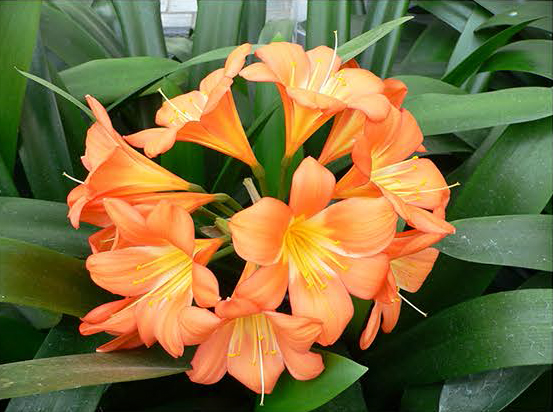
Clivia miniata, known as the Natal lily, is a plant that doesn’t need elaborate staging to make an impression. Its deep green, glossy leaves create a calm backdrop, while the winter-to-spring orange blooms bring energy to interiors exactly when it’s needed most. At 4Nature System, we see it not merely as decoration, but as an element of a consciously designed, biophilic workspace.
Clivia miniata – from the humid forests of Africa to modern interiors
The Natal lily originates from southern Africa. In nature, it grows in humid deciduous forests, often on slopes and in cloud forests. It is an understorey plant – accustomed to filtered light beneath the tree canopy and stable soil conditions.
Why does this matter? Because its natural habitat closely resembles the conditions found in many offices:
- diffused light,
- moderate humidity,
- no direct, scorching sunlight.
This “forest growth logic” means that Clivia miniata thrives in reception areas, relaxation zones, and workstations with access to east- or west-facing light. In our 4Nature System projects, we frequently use plants of a similar character in installations such as living plant walls, where stability and predictable growth are key.
Light, stability, and the place of Natal lily in vertical gardens
Clivia is not a classic “vertical” plant. It has a substantial root system and prefers stable substrate. However, this doesn’t mean it cannot be part of a larger composition.
It performs best in:
- large installations with good drainage,
- systems with controlled, automated irrigation,
- pot modules and green furniture.
In practice, this means Clivia miniata more often finds its place in solutions such as furniture with built-in vertical gardens – for example in our 4Nature Basic, 4Nature N’joy and 4Nature Amstel systems, where it can grow in a more stable mass.
It prefers bright but indirect light. Direct sun can scorch the leaves. In semi-shade it still maintains a decorative form, though flowering may be reduced.
In the context of designing vertical installations, it’s worth reading our article on how to design greenery in the office, where we show how plant selection affects the longevity of the entire system.
Clivia miniata, air quality, and employee wellbeing
The large, leathery leaves of Clivia contribute to the indoor microclimate. The plant naturally participates in the transpiration process, meaning it supports air humidification. In modern offices, where air is often dried out by air conditioning, this has a real impact.
But the influence of Clivia miniata goes beyond technical parameters. Its presence:
- creates visual calm,
- softens the harshness of architecture,
- introduces seasonal colour in winter and early spring.
This is particularly relevant in the context of research on the impact of plants on workplace comfort and concentration. From an ESG perspective, the presence of living greenery is no longer merely an aesthetic addition — it becomes a conscious decision by a company that cares about people and the environment. In this context, Clivia miniata can be a small but very clear signal of that change.
Caring for Natal lily without overcomplicating things
One of Clivia’s greatest advantages is its predictability. It doesn’t require daily attention, but it dislikes extremes.
Key guidelines:
- moderate watering – when the top layer of substrate has dried out,
- reduced watering in winter,
- no standing water,
- fertilising in spring and summer with a flowering plant fertiliser,
- repotting every 3–5 years into a stable, heavier pot.
To flower, it requires a cooler winter rest period (approx. 10–15°C). In office spaces, this means thoughtful planning of its location is essential.
It’s also worth noting that the plant contains alkaloids and is toxic if ingested – which is why in public projects we always assess its placement with safety in mind.
Clivia miniata in 4Nature System projects – when is it the right choice?
At 4Nature System, we treat plants as an architectural element, not an afterthought. Clivia miniata is the right choice where you need:
- a stable form,
- a strong, seasonal colour accent,
- a plant with a distinct, structured leaf.
It is not the first choice for dynamic, lightweight vertical compositions. But it excels in vertical gardens at reception areas, in transitional zones, and in calm executive spaces.
If you’d like to see how we design green walls in practice, take a look at our article. Because a well-chosen plant is more than decoration. It’s a design decision that genuinely affects people’s comfort and an organisation’s image.
Frequently asked questions about Clivia miniata
Is Clivia miniata suitable for a vertical garden?
Yes, but it works best in larger, stable modules with good drainage. Due to its extensive root system, it is more suited to green furniture than lightweight wall compositions.
What light is best for Natal lily?
It prefers bright, diffused light – an east- or west-facing position is ideal. It dislikes direct sunlight, which can scorch the leaves.
How often should Clivia miniata be watered?
Water moderately, only once the top layer of substrate has dried out. In winter, the amount of water should be noticeably reduced.
Why is my Clivia not flowering?
The most common reason is the absence of a cooler winter dormancy period. The plant requires temperatures of around 10–15°C to initiate flowering.
Is Natal lily safe in an office?
The plant contains alkaloids and is toxic if ingested, so it should be placed out of reach of children and animals. In office environments it poses no risk when properly positioned.
Sources:
https://www.gbif.org/species/5326277
https://www.chicagobotanic.org/plant-information/plant-finder/clivia-miniata-natal-lily