
How should you light plants in the office? Choosing the right lighting for pot plants

Plants in the office can completely transform the work atmosphere – as long as they’re actually growing, not just “standing there.” In many open spaces, there’s less light than it seems, and standard office lighting isn’t always sufficient for photosynthesis. If leaves are yellowing, the plant isn’t putting out new shoots, or it’s “reaching” toward the window, that’s a signal it needs support. Find out how to supplement light for plants, what type of lighting to choose, and how to do it smartly – without wasting energy.
Why do office plants need supplemental lighting?
Because deep in an open space, the intensity of photosynthetically active radiation (PAR) can simply be too low to sustain proper photosynthesis. And without it, a plant doesn’t grow – it just “survives.”
It may seem bright in the office. The lights are on, the windows are large. But in practice, a plant sitting a few meters from the window may receive several times less light than one right by the glass. And that makes an enormous difference.
Large rooms with a single row of windows, blinds, partitions, or north-facing exposure mean that light in the middle of the office is diffused and weaker than it appears. There are also other, less obvious factors:
- tinted glass and solar films that reduce the amount of radiation,
- tall furniture blocking light from reaching the lower parts of plants,
- large distance between workstations and the building facade,
- shorter daylight hours during autumn and winter.
And this is exactly where the question arises: how to supplement light for plants so they don’t lose their color, firmness, and ability to purify the air? Because well-designed plant lighting isn’t decoration. It’s their real “fuel.”
Research on office greenery shows that plants can improve subjective air quality by as much as 20–30%. Sounds good, right? But it only works when the plant is healthy and actively photosynthesizing.
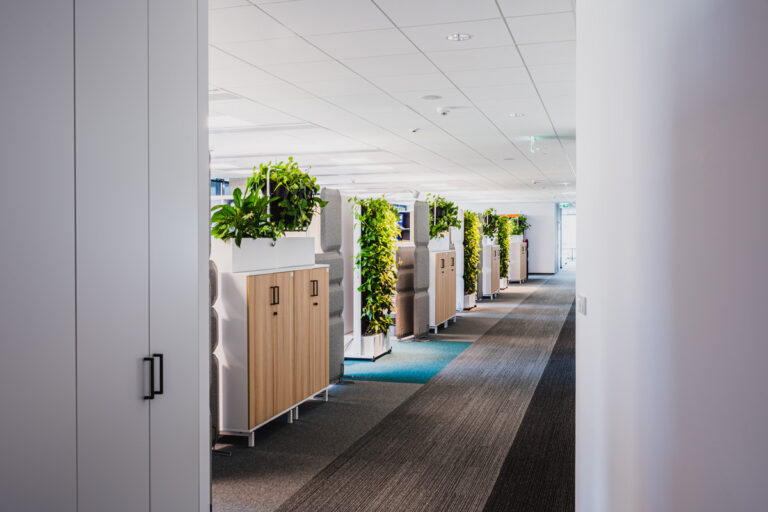
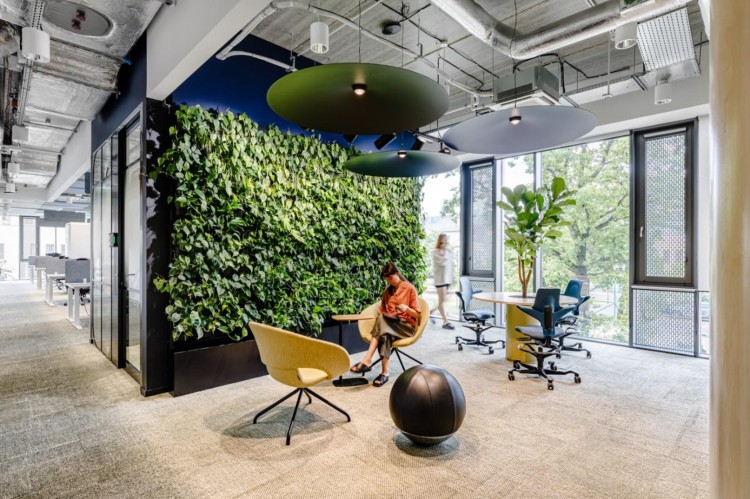
In projects such as vertical gardens or green walls in offices, we plan lighting from the very beginning as part of the entire system. At 4Nature System, we look not only at design but also at the actual light intensity distribution – from the reception area to the deepest zones of the open space. If plants are placed far from windows, there’s no point hoping it will “sort itself out.” Supplemental lighting for potted plants stops being optional. It becomes a necessity.
And if you want to better prepare your plants for the period of reduced light, especially in autumn and winter, check out our guide where we explain how to care for houseplants in winter – you’ll find practical tips to keep your greenery in good condition throughout the season.
Plants that don’t need light – do they really exist?
No, plants that don’t need light don’t exist – every plant needs light for photosynthesis. The popular query “what flowers don’t need light” is a mental shortcut. In practice, it refers to species that tolerate very low light intensity and can survive in shade for a long time.
Low-maintenance plants include, among others:
- ZZ plant (Zamioculcas),
- snake plant (Sansevieria),
- cast iron plant (Aspidistra),
- peace lily (Spathiphyllum),
- some Aglaonemas and Philodendrons.
These are typical plants that do better in offices than tropical ficus or monstera. However, “doing better” doesn’t mean “growing intensively.” At low PPFD levels, they grow more slowly, push out leaves less frequently, and are more susceptible to overwatering.
In projects like living plant walls, we don’t rely solely on selecting shade-tolerant species. Lighting is planned systematically – so that every layer of the composition has the right conditions.
At 4Nature System, we know that even the most resilient plants need 8–12 hours of exposure at moderate intensity to maintain a healthy appearance. Lack of light doesn’t kill a plant immediately – but it gradually weakens it.
What type of light for plants works best in an office?
The best light for office plants is light with the right spectrum and sufficient exposure time – most often diffused, white 4000–6500K with a blue component. When thinking about what type of light to choose for plants, it’s worth distinguishing three key aspects.
Diffused light for plants
The most comfortable option for an office. It doesn’t glare at employees, evenly illuminates leaves and reduces the risk of spot burns. This is the most commonly chosen option in commercial spaces.
Blue light for plants (400–500 nm)
Strongly supports leaf growth and the photosynthesis process. It is crucial for the development of green parts, but in its pure form it is rarely used in offices for aesthetic reasons.
Supplementing plants with white light
The most universal solution. Full-spectrum LEDs at 6000–6500K replicate daylight and work well for both individual pots and larger installations.
For systems such as vertical gardens, lighting is planned at the design stage. At 4Nature System, we combine the right color temperature with intensity control, so plants grow steadily and the space maintains a professional character.
What to use to supplement plant lighting in the office? The best sources of artificial light
Full-spectrum LEDs are the best option for supplementing plant light in offices. They are energy-efficient, durable, and provide a spectrum that genuinely supports photosynthesis. And that means one thing – the plant doesn’t just “stand there,” it actually grows.
If you’re wondering what to use to supplement plant lighting, consider three options:
- Full-spectrum LEDs 4000–6500K – energy-efficient, durable, close to daylight,
- LED panels for larger green zones – suitable for larger arrangements,
- fluorescent tubes – cheaper, but less energy-efficient.
Modern artificial lighting for potted plants uses up to 40–60% less energy than older technologies (e.g. HPS). The growth effect can be comparable, but the electricity bills are significantly lower. For example: a 30–50W lamp running 12 hours a day costs around a few dollars per month at standard electricity rates. That’s less than a daily coffee for the team.
In practice, artificial light for plants also allows for full cultivation without window access. Yes, it’s possible. A properly configured setup for growing plants under artificial light works – as long as you provide the right intensity and maintain a day–night cycle.
In larger installations – such as a mobile vertical garden – lighting is not an add-on. It’s part of the construction. Not a lamp “somewhere on the side,” but a system designed together with the plants.
How to supplement light for office plants step by step
To effectively supplement light for office plants, you need to select the right lighting duration, lamp distance, and smartly combine artificial with natural light. This isn’t about a random desk lamp. It’s about a repeatable, well-thought-out approach.
How many hours per day?
Lighting duration is the foundation – without it, even the best lamp won’t do its job. Most office plants need a regular, daily light cycle that mimics the natural day.
The most common guidelines are:
- 8–12 hours for shade-tolerant species,
- 12–16 hours for tropical and flowering plants.
If you only light for 2–4 hours, the effect will be minimal. The plant will survive, but it won’t develop. On the other hand, lights on 24/7 is also a bad idea – plants need a “night” phase to maintain their natural circadian rhythm. A consistent cycle is the key to stable growth.
How far should the lamp be placed?
The distance of the lamp from the leaves matters enormously. Too far – the light loses its intensity. Too close – the plant can suffer.
General guidelines:
- small plants: 15–30 cm (6–12 in),
- larger pots: 30–50 cm (12–20 in).
If the lamp is too close, drying out and leaf damage can occur. Sometimes it’s not immediately visible – leaves become dull and edges start to curl. It’s worth observing the plant during the first few days after setting up the lighting and adjusting the distance if needed.
How to combine natural light with a lamp?
It’s best to treat the lamp as a supplement, not a replacement for daylight – if you have window access at all. In practice, running the lamp in the morning and afternoon works well, when outside light is weaker.
A timer is a simple yet very effective solution. You set fixed hours and don’t need to remember to switch the light on and off every day. This gives the plant a stable rhythm, and you don’t waste time on it.
The most common mistakes when supplementing light for potted plants
Even good lamps won’t help if they’re used haphazardly. Many plant problems in offices don’t stem from lack of equipment, but from incorrect settings and bad habits. Often it “seems bright,” yet the plant still doesn’t have the conditions for proper photosynthesis. The most common mistakes are:
- light coming from the side or below,
- no day–night cycle,
- insufficient intensity despite an apparently “bright” room.
In systemic greenery projects at 4Nature System, we first analyze existing light conditions, and only then select plants and lamps. This approach works equally well for individual pots and for complex installations such as green walls or vertical gardens. If you want to understand more broadly the importance of light for plants and people, it’s worth remembering that well-designed lighting affects not only photosynthesis, but also workplace comfort.
Frequently asked questions about supplementing plant light in the office
Is regular office lighting enough for plants?
Often not. Standard office lamps are designed for human eye comfort, not for photosynthesis. They may give the impression of brightness, but their intensity and spectrum can be too weak for a plant to grow steadily. In many cases, additional dedicated supplemental lighting is needed.
How to supplement light for plants in a windowless office?
In spaces without access to daylight, it is necessary to rely fully on LED lamps with the appropriate spectrum (most often 4000–6500K). Plants should be provided with 8–16 hours of light per day – depending on the species – and a clear day–night cycle must be maintained. With properly matched intensity, plants can function exclusively under artificial light.
How many hours per day should potted plants receive supplemental light?
For shade-tolerant plants, 8–12 hours is usually sufficient. Tropical and flowering species need 12–16 hours of light. Shorter periods (e.g. 2–4 hours) usually have no effect, while leaving lights on around the clock disrupts the plant’s natural rhythm.
Do plants exist that don’t need light?
No. Every plant needs light for photosynthesis. However, there are species that tolerate very low intensity, such as ZZ plant or snake plant. They will ‘survive’ in the shade, but without adequate light they won’t develop intensively.
Is blue light for plants necessary in the office?
The blue spectrum (400–500 nm) strongly supports leaf growth and photosynthesis. In office practice, however, full-spectrum light is most commonly used, which contains a blue component but is more visually pleasant for employees.
How far from the plant should the lamp be positioned?
Small plants are usually supplemented from a distance of 15–30 cm, larger pots – 30–50 cm. A lamp that is too close can lead to leaf drying, while too great a distance reduces light effectiveness. It’s worth monitoring the plant and responding to the first signs of stress.
Is supplementing plant light in the office expensive?
Modern LEDs are energy-efficient and use up to 40–60% less energy than older technologies. A 30–50W lamp running 12 hours a day generates a cost of a few dollars per month. Compared to the visual effect and impact on workplace comfort, it is a relatively small investment.
Sources:
https://migrolight.com/blogs/grow-light-news/energy-saving-with-led-grow-lights
https://www.gorillagrowtent.com/blogs/news/do-grow-lights-use-a-lot-of-electricity