
The elegant chamedora – a tropical palm that brings a sense of calm to the office and adds structure to a green wall

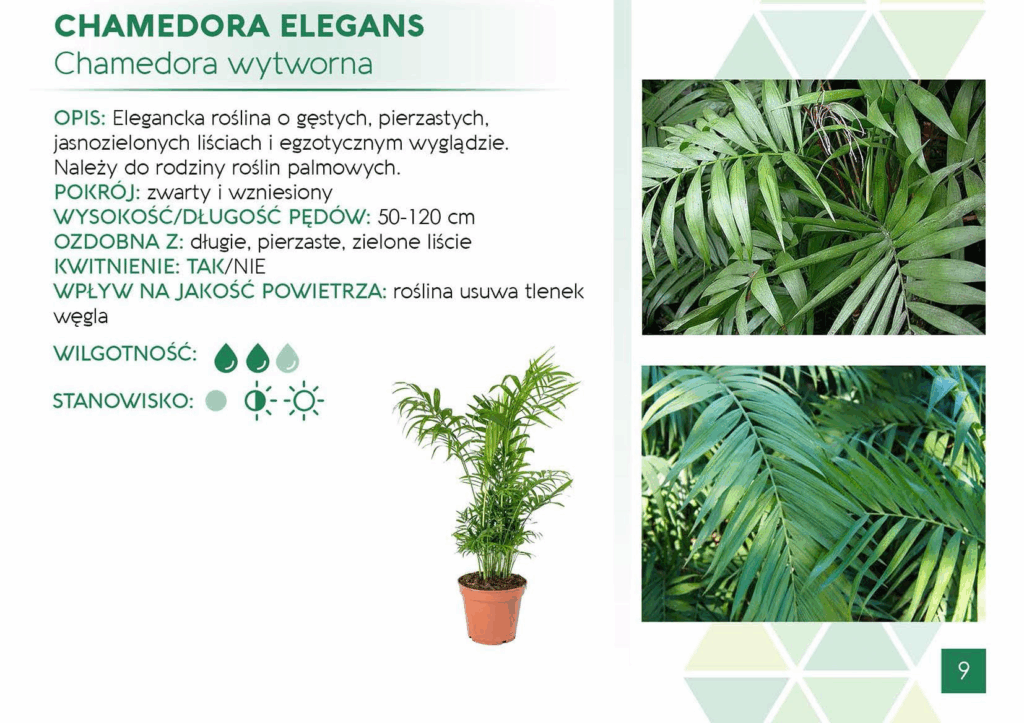
Chamaedorea elegans is one of those plants that doesn’t need the spotlight to do a great job. It has delicate, feathery leaves, a bright green color, and a compact form. It brings lightness to interiors while also building structure. At 4Nature System, we frequently use it in office greenery projects because it’s predictable, safe, and adapts very well to vertical systems. And as a bonus, it genuinely supports air quality.
The natural habitat of Chamaedorea elegans – why does it thrive so well in offices?
Chamaedorea elegans originates from humid, shaded tropical forests of southern Mexico and Guatemala. In nature, it grows as an understory plant – beneath the canopies of larger trees. This is important information. From the very beginning of its “life,” it was never accustomed to harsh sunlight. It grew in partial shade, in stable humidity, in a calm microclimate.
In its natural environment, it can reach up to 2–3 meters in height, forming dense clumps with slender stems and feathery leaves. In office conditions it is more compact, making it an excellent choice for:
- green walls,
- relaxation zones,
- reception areas,
- glazed spaces and open-plan offices.
At 4Nature System, we select it for projects such as living walls and vertical gardens, where combining aesthetics with durability is key.
How much light does Chamaedorea elegans need in a green wall?
One of the greatest advantages of the parlor palm is its tolerance for lower light levels. It functions well at just 50–250 lux. Of course, it thrives best in bright, diffused light, but it does not require direct sunlight. Quite the opposite – strong rays can damage the leaves.
This means that:
- it performs excellently in offices with limited access to natural light,
- it tolerates artificial lighting well,
- it works well deep within open-plan office spaces.
In systems such as furniture with built-in vertical gardens – for example in the 4Nature Basic, 4Nature N’joy or 4Nature Amstel models – it builds a soft, tropical structure without the risk of being “temperamental.”
If you’re interested in the topic of designing greenery in offices, we recommend our post where we share practical tips.
Does Chamaedorea elegans really improve air quality in the office?
The parlor palm is classified among air-purifying plants. It helps remove, among others:
- benzene,
- formaldehyde,
- xylene,
- toluene,
- carbon monoxide.
Additionally, it affects air humidity. In office spaces where air conditioning often dries out the microclimate, this matters. And better humidity means:
- less fatigue,
- fewer respiratory irritations,
- greater work comfort.
In a business context, it’s worth reading our article on the impact of greenery on the well-being of office employees. At 4Nature System, we view plants not as decoration, but as an element supporting health and team performance.
How to care for Chamaedorea elegans in the office?
This is a relatively easy plant to maintain. Just keep a few rules in mind:
- water 2–3 times per week in summer (when the top layer of soil has dried out),
- reduce watering to approximately once a week in winter,
- avoid hard, cold water,
- maintain air humidity above 50%,
- fertilize every 2–3 weeks from spring through autumn.
The most common problem? Drying out. Browning leaf tips are a signal that the plant needs more moisture.
Chamaedorea in 4Nature projects – a proven foundation for compositions
Because it’s predictable. Because it tolerates office conditions well. Because it builds a natural, calm structure for a green wall. And importantly – it is safe for people and animals.
In biophilic design projects, the parlor palm plays the role of a stable compositional base. It doesn’t dominate the space. It doesn’t shout with color. It simply does its job. And that’s precisely why it works so well in modern offices, hotels, and commercial spaces.
If you’re looking for a plant for a green wall that combines aesthetics, resilience, and a real impact on work comfort – Chamaedorea elegans is a very sensible choice.
Frequently asked questions about Chamaedorea elegans
Is Chamaedorea elegans suitable for an office with little light?
Yes. Chamaedorea elegans tolerates partial shade and lower light levels well, making it suitable for the depths of open-plan offices and workstations located far from windows. It is important to avoid direct, harsh sunlight.
How often should you water Chamaedorea elegans in office conditions?
In summer, usually 2–3 times a week; in winter, about once a week – always after the top layer of soil has dried out. The plant dislikes overwatering and standing water.
Does Chamaedorea elegans really purify the air?
Yes, it is classified among plants that support the reduction of pollutants such as benzene and formaldehyde. It also improves air humidity, which translates into greater work comfort.
Is Chamaedorea elegans safe for people and animals?
Yes, it is considered a non-toxic plant. This makes it suitable for use in offices, hotels, and commercial spaces without concerns about user safety.
Will Chamaedorea elegans work in a green wall or plant furniture?
Absolutely. Its compact form, resilience, and tolerance for partial shade make it an excellent choice for green walls and furniture systems with built-in plants.
Sources:
https://www.cabidigitallibrary.org/doi/10.1079/cabicompendium.14347