
How to create a chill-out area in the office? Our plant-inspired ideas

A well-designed relaxation space can transform the atmosphere of an entire office. In the world of hybrid work, it’s not the desk but comfort that determines whether people want to return to the company. If you care about genuinely supporting concentration and reducing stress, you need more than a sofa and a coffee machine. Find out how to create a zone that truly regenerates – with plants in the starring role.
Office Chillout Zone – Why Is It Worth Creating One?
A chillout zone in the office is a dedicated space designed for short regeneration, unwinding and informal team conversations. Its purpose is to cut off the stimuli typical of open-plan offices and create a safe place for a reset.
Research shows that noise in open-plan offices can reduce productivity by as much as 66%, while contact with nature increases employee wellbeing by around 15%. These are concrete numbers. In practice, this means less tension, better focus and lower staff turnover.
A well-designed chillout room at work acts as a buffer between intensive tasks and recovery. In such a place, you can:
- put your laptop aside for a moment,
- have a conversation in a less formal atmosphere,
- do a short stretching routine,
- unwind before the next meeting.
More and more companies treat such a relaxation space as an element of their employer branding strategy. According to market analyses, organisations investing in wellbeing record 20–30% lower employee turnover. This is not a “show-off” benefit, but real support for the team.
In the projects we carry out at 4Nature System, we can clearly see that companies which combine a rest zone with a green system build the image of a responsible and modern employer faster.
See what a functional and green relaxation zone in an office can look like in practice. In our implementations we show concrete deployments that combine design, technology and a real impact on workplace comfort.
Office Relaxation Room – What Equipment Is Essential?
A company relaxation room should be designed so that from the very first step it signals: slow down here. The key elements are ergonomics, acoustics and lighting.
The basic equipment includes:
- comfortable modular sofas and poufs,
- soft textiles that improve acoustics,
- warm-coloured lighting (approx. 3000–4000K),
- natural elements – wood, linen, plants.
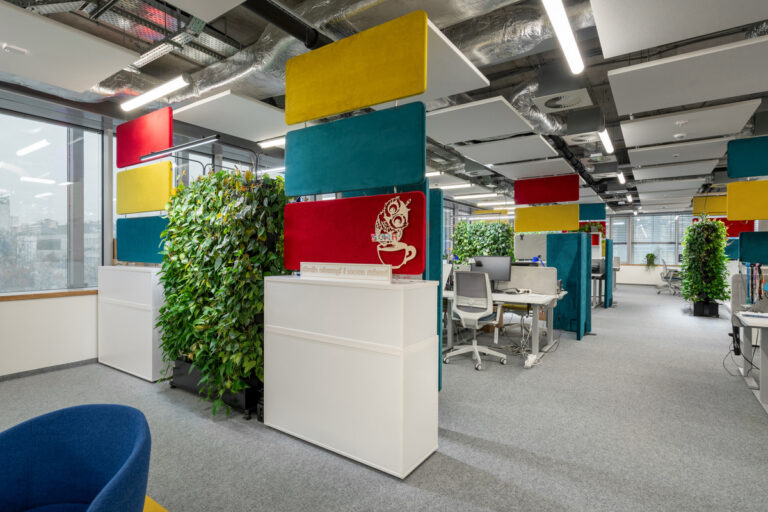
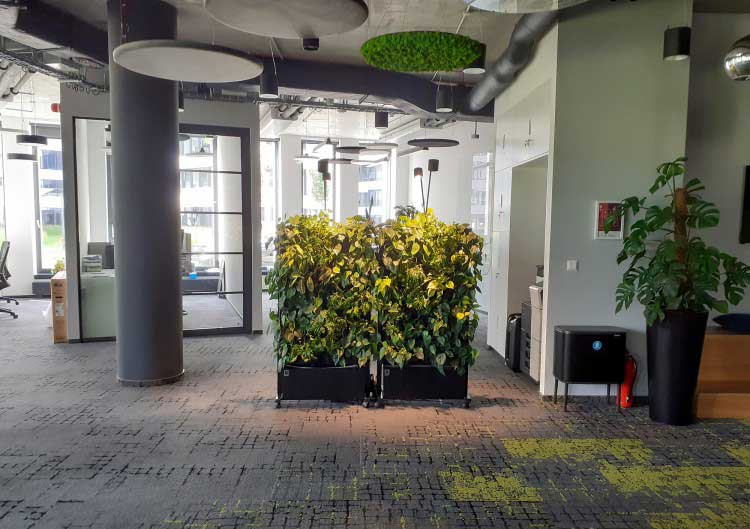
In many implementations we observe that a company relaxation zone works best when it is visually separated from the work area. This can be achieved not only with a wall, but also with a green partition.
In small offices, a mobile solution works well, such as a mobile vertical garden. Such an element not only divides the space, but also improves acoustics and the microclimate.
It is also worth thinking about:
- a quiet zone for a short nap,
- a reading corner with books,
- a space for informal meetings of 2–3 people.
A well-designed chill room at work is not overloaded with gadgets. What matters is coherence and sensory comfort. Overly bright lighting, echo or lack of ventilation can reduce effectiveness by as much as 20%.
Relaxation Zone and Plants – How Does Greenery Support Recovery?
A relaxation zone with plants works more powerfully than one without greenery, because it affects both the psyche and physiology simultaneously. Contact with nature lowers cortisol levels and improves concentration.
Reports on biophilic design indicate that offices with natural elements:
- increase productivity by 6–8%,
- reduce sick-day absences by as much as 30%,
- improve employee mood by 25–40% over the course of several months.
That is why relaxation zones in offices increasingly rely on green walls and vertical systems. In spaces where visual impact and air quality matter, a vertical garden works excellently. For larger arrangements we also recommend a living plant wall.
Such an installation becomes not only a backdrop for rest, but also a prestigious element. In 4Nature System projects we frequently use systems that allow for humidity optimisation and intelligent irrigation, which translates into a real improvement in microclimate.
Plants are not decoration. According to NASA research, selected species can remove up to 87% of toxins from the air under controlled conditions. In an office, this means better breathing and less fatigue.
If you want to understand more deeply how plants make a regeneration zone perfect, read our article. We present there the mechanisms by which greenery works in an office and the research findings confirming its impact on wellbeing.
Which Plant Species Work Best in a Chillout Zone?
The best plants for a chillout zone are air-purifying species that are easy to maintain and visually calming. The selection of species should take into account access to light, humidity levels and the intensity of use of the space.
Air-Purifying Plants
Peace lily (Spathiphyllum) effectively reduces volatile organic compounds present in office air. It also raises humidity, which matters in air-conditioned interiors. Its elegant white flowers bring visual calm.

Sansevieria is one of the most resilient plants for an office. It produces oxygen even at night, tolerates lower light levels and irregular watering well. It performs excellently in intensively used spaces.

Chlorophytum (spider plant) is known for its high effectiveness in removing formaldehyde and other pollutants. Its light, cascading leaf form gives interiors a natural freshness.

Relaxation Plants
Ferns (e.g. Nephrolepis) increase air humidity and have a soothing effect thanks to their delicate, soft leaf structure. They create a “green cloud” effect that promotes tranquillity.

Lavender has a subtle, natural fragrance that supports relaxation and tension reduction. It works best in well-lit relaxation zones.

Decorative Plants
Monstera has large, perforated leaves that create a sense of tropical calm and elevate the prestige of the arrangement. It is a plant that instantly catches the eye and warms up the interior.

Areca palm has a light, airy leaf form that lends the space elegance. It brings dynamism without overwhelming the interior and works well in larger relaxation rooms.

If saving space is a priority, consider a vertical garden. Such a solution allows you to introduce dozens of plants on just a few square metres of wall, without taking up any usable floor space.
A well-designed relaxation room with greenery becomes a zone to which employees return intuitively – not because they “have to”, but because they feel a real difference in comfort.
Relaxation Zone Design – Inspiration for Modern Offices
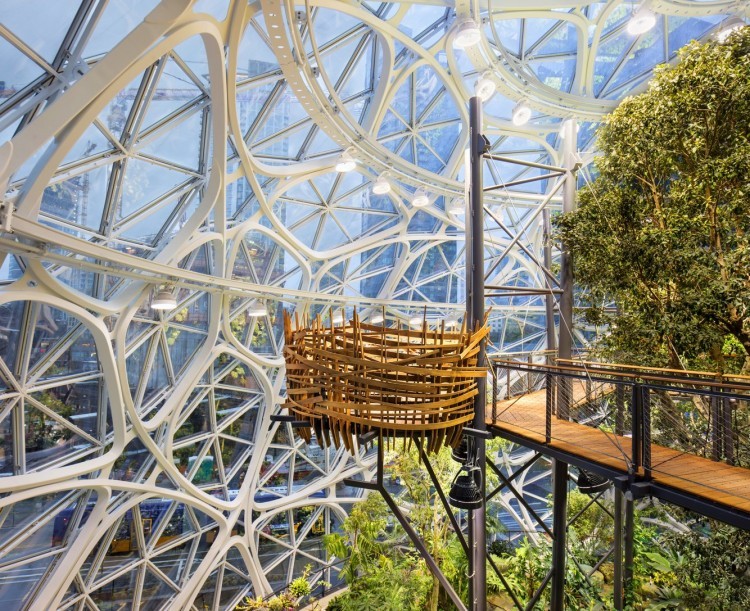
A modern chillout zone combines greenery, natural light and modular spatial solutions. It is no longer just a sofa in a corner, but a well-thought-out composition supporting recovery.
Companies increasingly opt for:
- green walls as a backdrop for sofas and armchairs,
- plant islands in the central part of the space,
- semi-open partitions integrated with vegetation,
- natural materials and a neutral colour palette.
In 4Nature System projects we use system-based solutions that allow the aesthetic and technological functions to be combined – automatic irrigation, modularity and the possibility of future expansion.
A well-designed company relaxation zone can become a brand showcase. Guests, business partners and job candidates immediately see that wellbeing is not a marketing slogan.
If you are planning to create your own chillout zone, opt for solutions that genuinely affect the microclimate and team comfort. Systemic greenery is not a trend – it is an investment in concentration, health and the image of a modern organisation.
Frequently Asked Questions About How to Set Up a Chillout Zone in the Office
What exactly is a chillout zone in the office?
It is a dedicated space designed for short recovery, unwinding and informal conversations. Its goal is to separate intensive work from moments of rest. A well-designed one supports concentration and reduces stress.
Does a chillout zone in the office really increase productivity?
Yes – research on biophilic design shows a productivity increase of 6–8% in spaces with natural elements. Additionally, stress reduction translates into better work quality and lower absenteeism. This is a real impact, not just an image-related benefit.
How much space is needed for a company relaxation room?
There is no single standard, but it is generally assumed that the zone should serve approximately 10–20% of the team at any one time. In small offices, a few square metres and mobile greenery elements are sufficient. The key is to separate it from the main work area.
Which plants work best in an office relaxation zone?
The best options are air-purifying species that require minimal maintenance, e.g. sansevieria, peace lily and spider plant. In larger spaces, monsteras and areca palms look great. Plants should be chosen to match the light and humidity conditions.
Does a vertical garden work in a small relaxation zone?
Yes, because it uses wall surface instead of floor space. It allows dozens of plants to be introduced without losing any usable area. It also improves acoustics and the microclimate.
How to ensure good acoustics in an office chill room?
It is worth using soft materials, acoustic panels or plant-based partitions. Systemic greenery naturally dampens sounds and reduces reverberation. This ensures the space genuinely promotes tranquillity.
Is a company relaxation zone only a benefit for large corporations?
No. Even small companies can create an intimate relaxation space using modular furniture and mobile greenery. It is the quality of the arrangement that counts, not the floor area.
How to convince management that investing in a chillout zone is worthwhile?
It is best to use data: lower turnover (20–30%), improved wellbeing and concentration, and a stronger employer brand. It is an investment in team efficiency and the company’s image. Such initiatives increasingly fit into ESG strategies as well.