
Cissus ‘Ellen Danica’ – natural lightness in green walls and the offices of the future
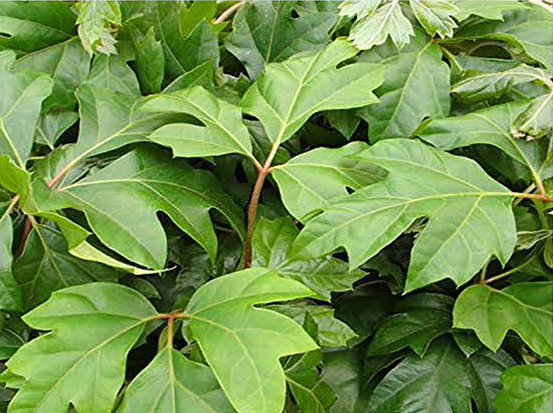
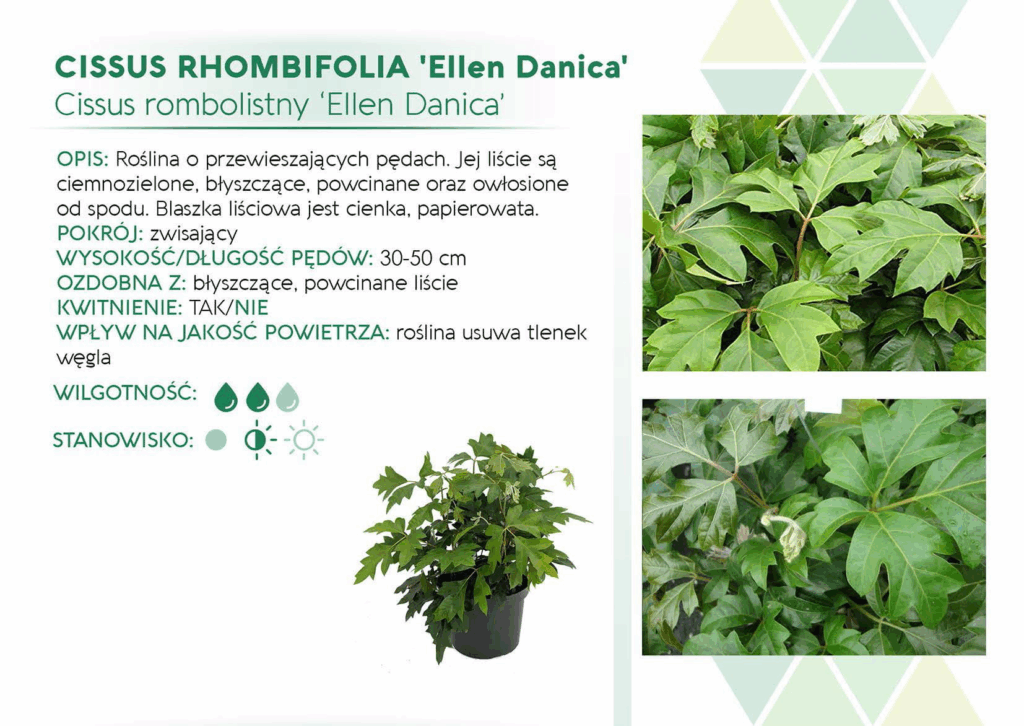
Cissus rhombifolia ‘Ellen Danica’ is a plant that doesn’t dominate a space — it subtly organises it. Trailing stems, glossy deeply-lobed leaves and a flexible growth habit make it an excellent choice for modern offices, hotels and commercial interiors. At 4Nature System, we frequently use it in green wall projects and furniture with built-in planting, because it is predictable, safe and delivers a beautiful, natural effect without excessive demands.
The tropical roots of Cissus ‘Ellen Danica’ — and why it thrives in offices
Cissus originates from the humid tropical forests of Central and South America. In nature, it grows in semi-shade, climbing trees and using them as support. This is an important design detail — it is an understorey plant, accustomed to diffused light and stable conditions.
In practice, this means that:
- it does not need direct sunlight,
- it tolerates indoor conditions well,
- it naturally forms cascades or climbs along structures.
This is precisely why it works so well in living plant walls and vertical garden installations. Its biology is in harmony with architecture — and that is no coincidence.
What light and conditions does Cissus rhombifolia ‘Ellen Danica’ prefer in vertical gardens?
It thrives in bright, diffused light. It grows well near east- and west-facing windows and also tolerates artificial lighting if it is properly designed. Direct, harsh sunlight? That is not its climate.
In vertical systems, the key factors are:
- good substrate permeability,
- controlled watering,
- stable temperature (18–25°C),
- moderate to elevated air humidity.
At 4Nature System, when designing green modules and furniture with built-in vertical gardens, we ensure proper drainage and water circulation. This means plants like Cissus are not at risk of overwatering — one of the most common mistakes in traditional pot cultivation.
Cissus looks excellent in our mobile solutions such as 4Nature Basic, in modular partitions like 4Nature N’joy, and in shelving units like 4Nature Amstel. It creates a soft, green structure that does not overwhelm the space.
Cissus rhombifolia ‘Ellen Danica’ — impact on air quality and employee wellbeing
Climbing plants like Cissus support natural air circulation and partially neutralise volatile organic compounds. They are not a “magic filter”, but in larger compositions they genuinely improve the microclimate. More importantly — they affect people.
From our experience and research on the impact of plants on office employee wellbeing, the presence of greenery:
- reduces stress levels,
- supports concentration,
- improves the subjective sense of comfort.
The trailing stems of Cissus bring lightness and softness to a space. In open-plan offices, they help visually define zones.
If you are interested in the topic of biophilia more broadly, it is also worth reading our post explaining how plants help create offices that attract people. Cissus is one element of this larger picture.
Cissus rhombifolia ‘Ellen Danica’ — low-stress care
This is a rewarding plant. It does not require daily attention, but — like most tropical species — it appreciates stable conditions. When provided with adequate light and controlled watering, it rewards you with a dense, healthy leaf structure and vigorous growth.
The most important care principles:
- moderate watering — the substrate should not be constantly wet,
- fertilisation during the growing season every 3–4 weeks,
- pruning in spring to encourage bushier growth,
- humidity control to reduce the risk of spider mites.
Cissus responds very well to pruning. Trimmed stems branch out quickly, which in vertical systems is a significant advantage — the plant naturally fills the module and builds the effect of a soft, green cascade. Furthermore, it propagates easily from cuttings, making it possible to maintain a consistent look across larger installations.
In our 4Nature System solutions, plant service and adaptation is standard. We monitor the condition of the greenery, adjust irrigation parameters and respond to the first signs of deterioration. As a result, Cissus is not a “problem plant” but a stable, predictable element of a professionally designed green wall.
Why do designers reach for this plant so readily?
Because it is design-safe. And in commercial spaces, that matters enormously.
- It is non-toxic to animals, which provides peace of mind in pet-friendly offices and spaces.
- It tolerates typical office interior conditions — stable temperature, air conditioning, diffused light.
- It creates a “green cascade” effect that softens architecture and breaks up the technical character of open-plan spaces.
- It combines aesthetic and biophilic functions — it is not merely decoration, but an element that genuinely shapes the perception of a space.
Cissus does not dominate an interior. It completes it. The trailing stems introduce movement, depth and natural layering that is so often missing from modern, minimalist offices. As a result, the space stops feeling “flat” and starts feeling more human.
At 4Nature System, we treat Cissus not as a single plant but as part of a larger concept — modern, sustainable work environments. Combined with other species, it builds the structure of a green wall, fills modules and creates natural partitions. It is a detail that works for the whole project.
And these details matter in the context of ESG. Greenery is not an add-on. It is part of the strategy — it affects employee wellbeing, company image and how a brand is perceived by clients. Sometimes it really is one climbing plant that transforms the entire feel of a space. It brings softness, balance and something that architecture alone cannot achieve. And yes — you notice it immediately.
Frequently asked questions about Cissus ‘Ellen Danica’
Is Cissus ‘Ellen Danica’ suitable for green walls in offices?
Yes, it is one of the climbing plants that performs very well in vertical systems. It naturally forms cascades and tolerates indoor conditions well, making it a safe and reliable choice for offices and commercial spaces.
What light is best for Cissus rhombifolia ‘Ellen Danica’?
Bright, diffused light is ideal. The plant dislikes direct, harsh sunlight but does well near east- and west-facing windows and under properly designed artificial lighting.
How often should Cissus be watered in a vertical garden?
Watering should be moderate. The substrate must not be constantly wet — it is better to allow it to dry out slightly than to overwater, which is the most common cause of problems.
Is Cissus safe for pets?
Yes, Cissus ‘Ellen Danica’ is considered non-toxic to dogs and cats. This makes it suitable for use in pet-friendly spaces.
Does Cissus genuinely improve air quality in an office?
In larger compositions it supports natural air circulation and helps improve the microclimate. In addition, its presence has a positive effect on employee wellbeing and the overall perception of the space.
Sources:
https://pmc.ncbi.nlm.nih.gov/articles/PMC7079878
https://plantiary.com/plant/cissus-rhombifolia_33.html
https://www.ukhouseplants.com/plants/cissus